

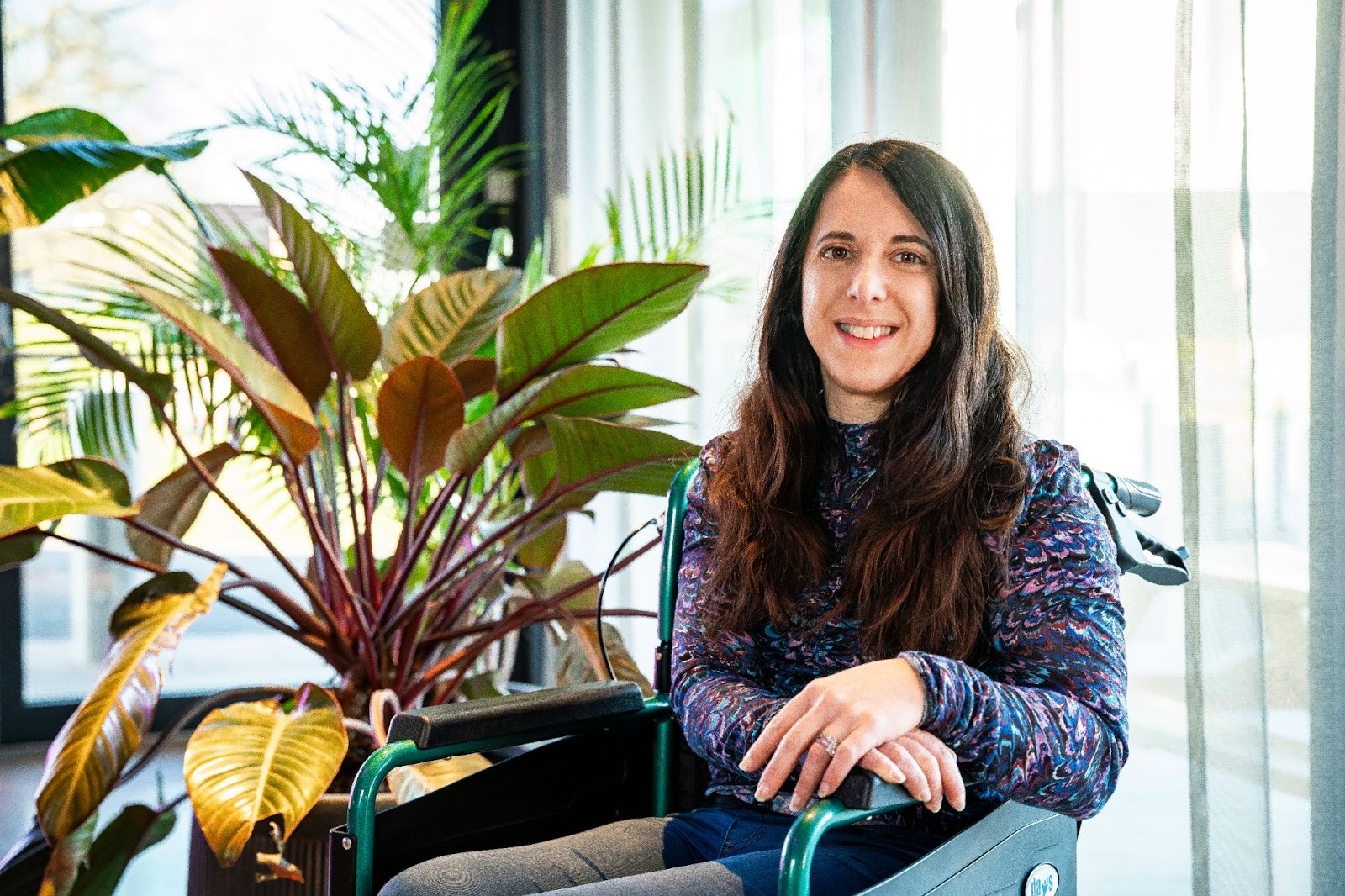
March 2026: This International Women’s Day, Georgina Colman, a founder and disabled advocate, shares her experience of navigating disability following her feature on BBC Panorama.
According to the ONS, 16.1 million people in the UK live with a disability and 3.8 million are entitled to PIP. Georgina Colman, a 49-year-old from Basingstoke, became disabled after a multiple sclerosis (MS) diagnosis in 2003.
She first knew something was wrong shortly after the birth of her son in 2002, when she started suffering from headaches and double vision. An MRI revealed she had white patches on her brain, and she was officially diagnosed with MS in April 2003. 13 years later, her walking started to deteriorate, and by 2018, she was using walking sticks and a wheelchair.
“No one prepares you to be disabled. It completely impacts every aspect of your life.” Mrs Colman said. “When I was first diagnosed, it was made to sound like a death sentence. While it can be challenging at times, it has changed my life, and many positives have come from it. I live a more stress-free life, I am healthier than I have ever been, and it inspired me to do something amazing – launching a business to help make a difference in the lives of other people living with a disability and becoming an ambassador for ADHD UK.”
BBC Panorama: The rising costs of health benefits
Mrs Colman’s multiple sclerosis and ADHD not only affect her day-to-day life, but it also impacts her finances. Speaking as an expert on a February 2026 episode of BBC Panorama, Georgina said: “It’s really easy to say, you’re taking taxpayers’ money, but the reality is, until you’ve been in that person’s shoes, you’ve got no idea.”
The BBC Panorama episode, released on Monday, 23rd of February, revealed that one in ten people in England and Wales claim health-related benefits, and the cost to the taxpayer is now £56 billion a year. The narrator explains that the sharpest rise is from people with mental health and behavioural conditions.
Georgina, who has also been diagnosed with ADHD, receives a Personal Independence Payment (PIP) for her MS, but has found it falls short in covering the true cost of living with a disability. “I go to neuro-physiotherapy twice a month, which costs £250 a month, as well as having sports massages, chiropractic appointments and other alternative therapies,” explained Georgina. “I need my heating on more as my body does not function well in the cold, which then costs more. I spend money on equipment like walking aids and assistive technologies, as well as on supplements and ‘free from’ food. These are not luxuries; they help me reduce the inflammation and spasticity in my body, which keeps me able to move more and therefore improves my quality of life.”
While presenting the calculations during the episode, Georgina said: “My monthly costs came to £1,798.58. When you look at how much I get from the government, which is just over £600 a month, it doesn’t cover even half of the costs that I have, in reality.”
This is true for many others as well, with research from Scope showing that on average, disabled households need an additional £1,095 a month, equivalent to £13,140 annually.
In the episode, Georgina is shown in her wheelchair, explaining that it costs just under £2,000. “There’s a lot of money that I spend on disability that someone else doesn’t have to. PIP is meant to level the playing field, but it doesn’t get close. It should help people with extra costs, so that they can be independent and remain independent for as long as possible, which would ultimately cost the government less in the long run.”
BBC Panorama also dive into Motability, a scheme which provides disabled people with a way to lease a new car, scooter or powered wheelchair. “I think it’s a lifeline for so many people in the disabled community,” Georgina explained. “It’s very easy for people to comment on the motability scheme when they are not disabled, or they don’t know anyone who’s disabled, and have no understanding of how, for some people, it really is the difference between staying in the house all the time or getting out and about.”
Supporting the disabled community through Purpl
Georgina’s determination to address these financial challenges gave her the idea to create Purpl, a savings platform for disabled people.
Purpl, mentioned on the BBC Panorama episode, launched in July 2024, and helps disabled people and people with long-term health conditions access discounts and exclusive savings. With the support of well-known brands like Morrisons, Carwow, Ocado, Iceland, Dunelm, and more, it has amassed a dedicated community of over 90,000 members who have saved about £2 million collectively. By using a few codes a month, Purpl members can save about £58 a month and £700 a year.
“Living with a disability is expensive, and costs can quickly add up,” shared Georgina. “I hope that through Purpl, we can help disabled people with their everyday expenses so life is a little easier and more affordable.”