

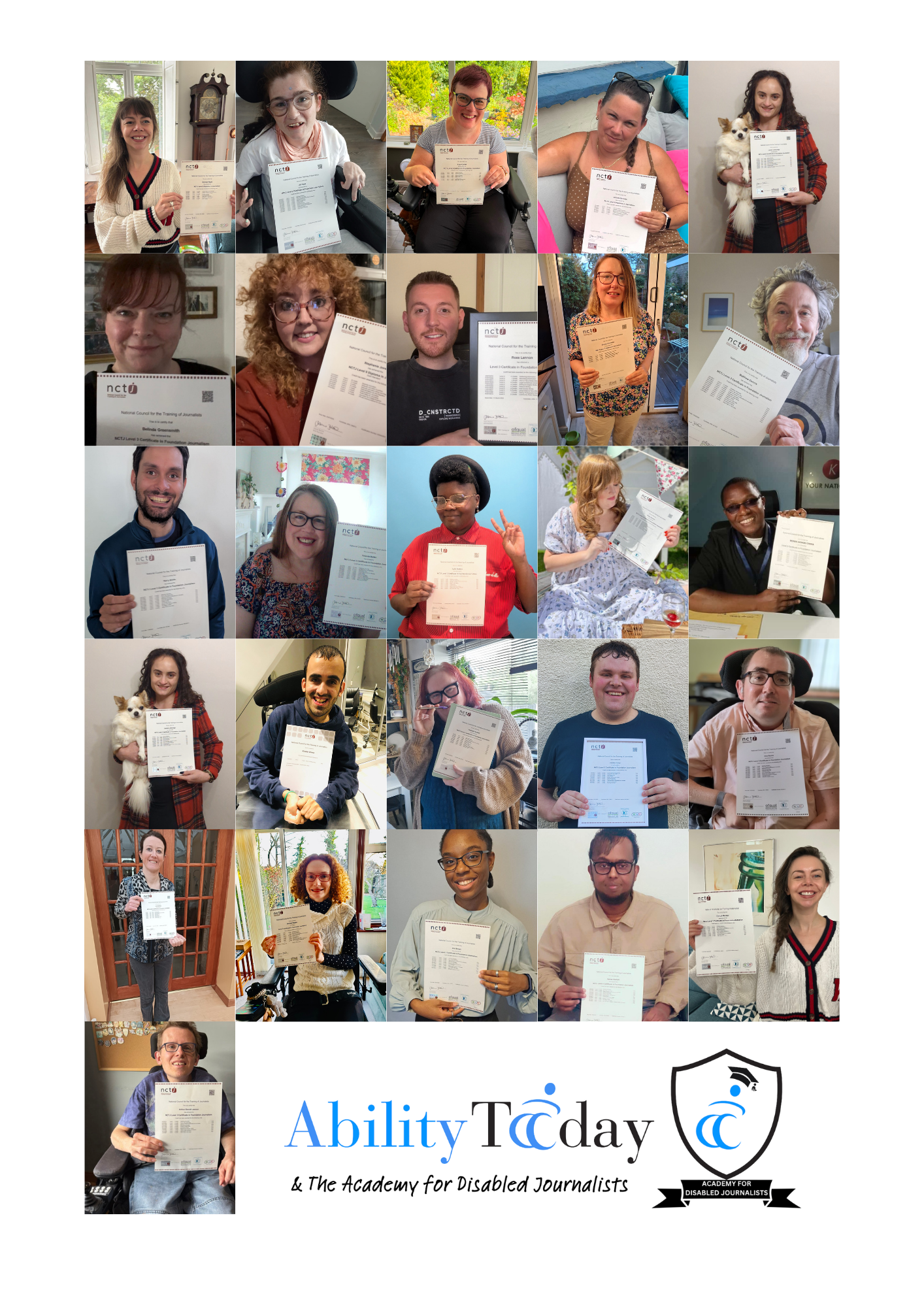
From the BBC and ITV to The Guardian and international broadcasting, graduates of the Academy for Disabled Journalists are proving that talent knows no barriers.
When Ability Today launched the Academy for Disabled Journalists in partnership with the National Council for the Training of Journalists (NCTJ) in 2020, the mission was clear: to give disabled people the opportunity to develop professional journalism skills and pursue careers in an industry where they have historically faced significant barriers. Six years later, the achievements speak for themselves. More than 100 disabled students have been supported through the Academy, with graduates progressing into professional journalism, broadcasting, national publications, freelance careers and new creative opportunities.
Behind every qualification, byline and newsroom appointment is an individual story of ambition, determination and achievement. Here are just some of the people who are making their mark.
Jamie Green: From the Academy to ITV Meridian
Jamie Green, who has cerebral palsy, is one of the Academy’s first inspiring career success stories. After progressing through the Academy’s NCTJ Diploma programme, Jamie secured an apprenticeship with ITV Meridian, giving him the opportunity to develop his skills in a professional television newsroom.
His hard work paid off when he subsequently secured a full-time newsroom position. Jamie’s journey demonstrates how accessible professional training, combined with practical industry opportunities, can create a pathway into employment.
Emily Davison: Turning a lifelong ambition into a career
For Emily Davison, becoming a journalist was a long-held ambition, she was an active blogger but didn’t feel a professional position in journalism was possible. Visually impaired, Emily joined our academy in 2021 and completed the NCTJ Certificate in Foundation Journalism very quickly. She was due to start our Diploma course before securing a trainee journalist position with Newsquest.
Her success is a reminder of why accessible education matters. Given the opportunity to develop professional skills and achieve an industry-recognised qualification, talented individuals can compete for positions within established media organisations. Emily’s achievement represents the transition from aspiring journalist to working professional.
Matt Bassett: Finding his place at BBC Wales
Matt Bassett, a tetraplegic journalist, initially faced uncertainty about how a full-time journalism career might fit around his disability-related needs. Through the Academy, he developed his skills and confidence before securing a BBC journalism apprenticeship and progressing into the BBC Wales newsroom.
Reflecting on his experience, Matt said: “The team at Ability Today were brilliant, giving me just the boost I needed.” His story highlights how access to the right training and encouragement can help talented people take steps towards careers they may previously have considered out of reach.
Georgie Wyatt: Making her mark at The Guardian
Georgie’s journalism journey has been one of steady and impressive progression. After completing both the Certificate in Foundation Journalism and the NCTJ Diploma through the Academy, she secured a place on The Guardian’s Positive Action internship scheme. She has since developed her experience through published bylines, freelance features and culture writing, and work on The Guardian’s features desk.
Her achievements show how professional qualifications can provide the foundation for a developing portfolio and a career spanning both newsroom and freelance journalism.
Harry Smith: Opening doors through The Guardian and KMTV
Harry Smith is another Academy student who has successfully gained access to competitive professional journalism opportunities. After securing a place on The Guardian’s Positive Action scheme, Harry gained valuable experience working alongside journalists, contributing research and ideas to video production and publishing work through the Communities desk.
Reflecting on his placement, Harry said: “The journalists I worked alongside couldn’t have been more supportive.” Harry has continued developing his practical journalism skills through a placement at KMTV. His progress illustrates the importance of connecting professional training with real-world newsroom experience.
Lauren Lethbridge: From the Academy to the Paralympics and the British Diversity Awards
Lauren Lethbridge’s achievements have given the Academy plenty to celebrate. Having developed her journalism skills through the Academy, Lauren went on to gain reporting experience at the Paralympic Games, a remarkable opportunity to cover one of the world’s biggest sporting events.
Her contribution to the Academy’s story was recognised in another way in 2026 when she represented Ability Today at the British Diversity Awards. Lauren collected the Academy’s Highly Commended recognition in the Community Project of the Year category. It was a proud moment for the entire Academy community, with one of its students representing the programme on a national stage.
Moses Chiira: From Nairobi to national broadcasting and inspiring others
One of the Academy’s most far-reaching success stories comes from Kenya. Moses Chiira, a visually impaired journalist from Nairobi, completed his Certificate in Foundation Journalism through the Academy before securing a professional journalism role with Kenya Broadcasting Corporation.
But Moses’s ambitions did not stop there. He went on to develop the VUKA Voiceover Academy, creating opportunities for other aspiring voiceover artists to develop their talents. In June 2026, seven students graduated from the programme, including four visually impaired participants.
Moses’s achievements demonstrate the wider impact accessible education can have. One person’s opportunity to learn can become an opportunity for many others.
More than journalism: Skills for a world of opportunities
While the Academy’s roots are firmly in journalism, the opportunities available to graduates extend well beyond traditional newspapers and broadcasting. A journalism qualification develops a powerful combination of transferable skills: research, critical thinking, interviewing, digital storytelling, communication, content production and the ability to work accurately to deadlines.
These skills are highly relevant across public relations, marketing, digital media, corporate communications, charities, public-sector organisations, publishing, government departments, and the creative industries. For disabled people who may face additional barriers to employment, these transferable skills can open doors across a much wider range of careers.
This is an important part of the Academy’s future ambition: not simply helping more disabled people qualify as journalists, but supporting them to translate their skills into sustainable paid employment across multiple industries.
Recognising the Academy’s growing impact
The Academy’s Highly Commended recognition at both the British Diversity Awards and European Diversity Awards were important milestones, acknowledging its contribution to creating opportunities and championing inclusion.
But the most compelling evidence of its impact is found in its students, and we’ve had too many successes to list them all. From Jamie’s career at ITV and Matt’s progression into BBC Wales, to Georgie’s published journalism, Harry’s industry placements and Moses’s international achievements, the Academy has helped talented disabled people gain access to opportunities in a highly competitive profession.
These achievements have been made possible through a combination of accessible online education, professional teaching, individual support, industry engagement and, above all, the dedication of the students themselves.
The next generation is waiting
Despite the achievements of its students and graduates, the Academy continues to face the challenge of securing sustainable funding. Its ambition is to build on the progress made since 2020, welcome new students and strengthen the connection between professional training and employment.
That means more mentoring, more newsroom placements, more employer engagement and more opportunities for students to turn their qualifications into paid work. The Academy has already demonstrated what can happen when disabled people are given access to professional education and genuine career opportunities.
Now the challenge is to make those opportunities available to more people. Our students are not asking for special treatment. They are asking for the opportunity to demonstrate their talent, develop their skills and build meaningful careers.
Academy for Disabled Journalists
An Ability Today initiative, delivered in partnership with the NCTJ