

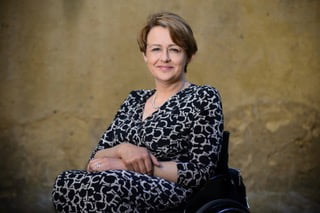
With just over one month to go until the Paralympic Games begin, I sat down with an icon of the athletics track to gain her insights into elite sport, disability rights and zombie fiction.
A retired Paralympian and now an independent cross-bench peer in the House of Lords, Baroness Grey-Thompson is possibly the most accomplished person I’ve ever encountered. Her career in wheelchair racing yielded an incredible 16 Paralympic medals (11 of them gold), a further 12 World
Championships medals and 30 World Records. As well as finding glory in sprinting and middle-distance events, Tanni also won the London Wheelchair Marathon six times before retiring from elite sport in 2007.
In 2005 she was endowed with a damehood and in 2010 was appointed a life peer in the upper chamber of Parliament. Armed with a politics degree, Tanni uses her platform to speak on issues including sports welfare and disability rights. She was involved in the bid for London 2012, has amassed a wealth of broadcasting credits and will be appearing on TV and Radio during
Paris 2024.
Any tips for me out in Paris?
Mostly, it’s saying what you see. And express your response. In broadcasting, a bit of emotion is always good. Winning, losing and everything in-between.
What events are you most excited for? Any Predictions?
The wheelchair racing at the athletics is always pretty good. I’m quite excited by that. I don’t name any athletes this close to the games, because I had a tendency that my names would get injured or dropped or something. If you look at the whole (Great Britain) squad, they’re hoping to win medals across all 19 sports. We’re pretty strong across a range.
China’s going to be top of the medal table. The number of disabled people they have in China is huge. It’ll be interesting to see how France do, both Olympics and Paralympics. They’ve had a mixed four years but home games brings people out. Ukraine has always been very strong for visually impaired athletes, it’ll be interesting to see what they’re able to do, and the USA’s getting stronger – there’s more media coverage in the USA, more support.
I’m kind of just looking forward to all of it. It’s been a long time coming for Paris.
When you look back over your own career, what’s the overriding emotion?
Relief! It went alright.
What the public don’t see is all the training and the effort that goes into it, and actually that’s really cool, it’s a lot of fun. But the bit the public see, it’s teeny. My career on the track at the Paralympics is 19 and a half minutes of my life, and it’s thousands of hours a year training.
You get to spend a lot of time with people you really like and care about. You get to travel and compete, and when it goes well it’s amazing, when it goes bad it’s not.
For me, I loved that pressure mostly. The only control you have is how hard you train and what you do to get there. There’s a finite amount of time.
You were a teenager at your first Paralympics in Seoul (1988). This year the ParalympicsGB squad includes athletes as young as 13. What kind of resilience do you need to compete on the world stage so young?
When they’re very young athletes there’s a lot of work that goes into making sure they’re protected and able to deal with all the emotions of being at the games because it can be lots of highs and lows.
I was always lucky that I got to compete in my first games without much expectation on me (Tanni nevertheless won bronze in the 400m), just to get used to being in the village, transport – everything is different from what you’re used to. The team puts a lot of preparation into getting athletes ready for what to expect.
It sounds a total first-world problem, but the hardest thing I ever had to deal with was that every day they decide what colour t-shirt you’re wearing: there’d be a big sign outside the chef de Mission’s office saying ‘today’s a blue t-shirt’, ‘today it’s a white t-shirt’. It’s around team spirit – and I’d always forget.
In your letter in the Dear NHS compilation (edited by Adam Kay) you thank the doctors who spoke directly to you as a child and said ‘you need to understand because you’re the one going through the operation’. Do you think that fostering of autonomy factored into your athletic mindset in any way?
It’s quite complicated really, because some of the things I had to deal with at a young age – making decisions on operations, healthcare – stuff which most people don’t get to do, I think then sometimes in sport you feel infantilised because you don’t make that many decisions.
You know, you’re told what camps you go to, what time you train and what time you provide a urine sample. I’m sure some of the team managers would have said I was quite difficult to work with because I wanted that autonomy over my career. I was really set on what I wanted my career to be, how I was going to train, who I put around me. Which I’m sure wasn’t always easy to deal with.
Some of the work I do now in terms of athletes transitioning out of sport and making their decisions, a lot of that is impacted by my own experience of impairment and disability, and my experience of the people around me who were very keen for me to make my own choices. My parents were both very strong on living an independent life, on education and work. Retired athletes can’t rely on other people to sort their career out for them. It all kind of intermingles.
What was your experience of that transition after retirement?
I started planning my transition at 21. I did a politics degree at university, I sat on various bodies and organisations – the National Disability Council, which oversaw the implementation of the DDA (Disability Discrimination Act 1995), I sat on Sport Wales, Sport England, UK Sport, did a bit of TV – all in my 20s. My plan was always to do a law conversion and become a lawyer, so I was always going to end up in this space. I just ended up being part of the group of people who make laws, not the ones who argue about it.
At the end of every year, my Dad used to say to me ‘right, you’ve spent all your pension on travelling the world, you haven’t got any money. What are you doing to do when you grow up?’ Most of my career was without lottery funding, so I was hyperconscious that nobody owed me anything. Just because you win medals on the track, that doesn’t guarantee you anything. But apparently someone said to my Dad that I’d end up in the House of Lords one day.
You could get injured and that’s it, you’re done. Or your performance director could decide you’re not quick enough anymore so you’re done. Regardless of your hopes and dreams and ambitions, someone else decides. So I always had plans. I knew before Athens that it would be my last. I kind of think more athletes should have someone like my dad because he was really good at that wider understanding.
You’ve often said that sports and politics are similar. How so?
You need a lot of resilience. You need to be in charge of your own destiny. It’s about how much you do every day. It’s where you find opportunities to debate the things you care about. You’ve got to be creative, you’ve got to be better next year than you were last year. They’re really similar.
The reality is that most of it’s dull and boring. Training on a Friday night doing 20 miles is not exciting, but competing in Sydney in front of 80,000 people is quite cool. Most of reading the briefing sheets and writing speeches is really dull, but when you’re in the chamber changing legislation that’s quite exciting. So they’re really, really similar.”
Do you see the upcoming Games as a political opportunity to spotlight not only access to sport, but disability rights in general?
The Paralympics is first and foremost an elite sporting event. The reality is that is has the secondary message.
I don’t see it as the responsibility of the Paralympic movement to change attitudes. In Tokyo they had a campaign called WeThe15 (15% of the world’s population is disabled). I don’t think the IPC (International Paralympic Committee) can change the lives of disabled people in every jurisdiction around the world, but it can nudge it. It can’t do everything, that’s the responsibility of governments and political parties.
A big frustration for me is when people say 2012 changed the world for disabled people. It didn’t. It gave us step-free access at King’s Cross and it changed some cobbles on the Southbank. It didn’t stop the discrimination disabled people experience every day. It’s usually non-disabled people who say 2012 changed the world, because it makes them feel warm and cuddly. But it’s not the Games’ responsibility to change the world.
There often seems to be a big gap in the offerings for disabled people between recreational activity and elite performance sport. How do we bridge that gap?
I still think there’s a lack of understanding about the difference between someone who’s on a recreational pathway and elite.
I struggle with everything being called ‘para’. If we’re talking about the Paralympic Games, I’m not sure we need to say para-athletics or para-cycling, because it’s a given. I struggle with it when people say parasport instead of disability sport, because when you call everything from recreational, a 12-year-old who does a bit of exercise once a month, right up to a Paralympian ‘para’, it blurs those lines. For me there’s disability sport, then pathway, then Paralympic sport. They’re quite different. Not many people agree with me on this, but I think it’s quite challenging if we call everything para.
I think it’s also about managing expectations. There is a point where you sell a dream of a gold medal and that brings children into sport. But telling any disabled child who vaguely does sport ‘you could be a Paralympian’ is not particularly fair. The reality is, however successful you are, at some point everybody is not good enough anymore.
What are your expectations of accessibility in Paris?
I’m a bit disappointed that they promised the metro was going to be accessible, and then they didn’t bother. Generally, access has improved for sportspeople, athletes. But if you’re a VIP or in the media, it’s like ‘but you’re meant to be an athlete.’ They don’t always think that you might have another role apart from being an athlete.
In London we spent a lot of time working on accessible seating – end of rows, you could sit with your family and friends. A lot of the time in the UK if you go to a sporting event, [wheelchair users] can sit with one person. London really turned that on it’s head and did some cool things. For me that was a big win. There’s big hand-overs between each of the Games, so hopefully some of the stuff that happened in London will continue to other Games.
What sport would you want to do other than racing?
Cycling or basketball. Probably cycling because it’s similar. I’m so completely useless at basketball, but I’d love to be better at it. Two months ago I joined a local club and started doing a bit of training. I’m so useless, I can’t throw, catch, or shoot. There was a little lad on the team, like 13, who asked ‘have you ever done any sport?’
Where do you keep your medals and accolades? Do they have a display?
Nothing. My medals are in a rucksack. ‘Um… [turning to check with her husband Ian] yeah one of my Sport Personality trophies is out, not the others. I don’t need to look at stuff to think about who I am. It’s part of my identity but I don’t need to see it every day. And my family would get quite bored of that.
Three things you can’t live without?
My phone, my kindle and my glasses.
Favourite book on said kindle?
Pride and Prejudice and Zombies (The parody of Jane Austen’s classic, by Seth Grahame-Smith)
“I get two books in one. I love Pride and Prejudice but the zombie twist is really funny.”
Your birthday is on Friday (26th), any plans?
I’m getting an honorary degree from Westminster University which is very nice and which my family are coming to. That’s about it really. Then I think I’m taking everyone out for dinner”
Honours and family, ‘that’s about it’ – it really does sum up the incredible paradox that is Baroness Tanni Grey-Thompson: a blend of prestigious achievement and down-to-earth understandement.
Thank you and Happy Birthday Tanni. Until Paris!
*Occasional edits for length*
By Lauren Lethbridge – ADJ CFJ Alumni & Diploma Student