

Excitement, extravagance – and no umbrellas!
Last night, Wednesday 28th August, Paris staged a magnificent show to welcome the 4,400 athletes who will compete in the City’s first ever summer Paralympic Games.
Held in the heart of Paris and outside of a stadium for the first time, the Place de la Concord was transformed into an open-air, 4,500m² stage to showcase para-sport to the world.
Athletes from 168 delegations paraded down the Champs-Elysées from the Arc du Triomphe, emblazoned with the Paralympic Agitos symbol, to be welcomed by more than 500 artists, 140 dancers (including 16 disabled performers) and 50,000 spectators.
The staging of the Opening Ceremony was master-minded by Swedish choreographer Alexander Ekamn, who was commissioned by Paris 2024 artistic director of ceremonies Thomas Jolly. Jolly called the ceremony “both festive and political”:
“Together we aim to transcend limits and make them coincide with a more equal and inclusive world.”
The artistic team also included Composer Victor le Masne, leading the musicians of Ensemble Matheus.
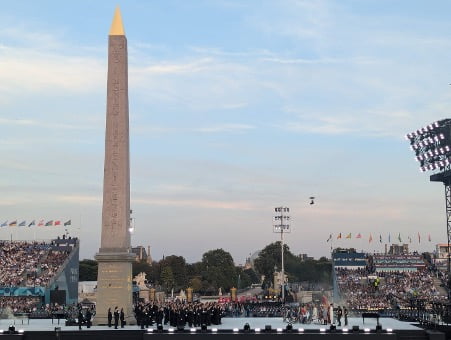
The Paris 2024 Paralympic Opening Ceremony at Place de la Concorde began with scenes of opposition, and ended with resolution.
The festivities kicked off with a sleek, monochrome dance piece incorporating a fleet of grand pianos, accompanied an original overture ‘Countdown’ by Canadian pianist Chilly Gonzales.
The arrival of a red sports car bedecked with Phryge mascots announced a tonal shift with a performance from French band Christine and The Queens performing their rendition of ‘Non, je ne regrette rien’, originally sung by Edith Piaf.
A new, inclusive cohort of dancers emerged in colourful and modern costumes to contrast with the hegemony of the suited ensemble. Sharp choreography with flags evokes a martial-like physicality of strictness and uniformity, set against the freedom and flair of freestyle.
The suited performers with their matching looks and moves were mesmerising – but strangely isolated compared to the colourfully diverse group of disabled and non-disabled dancers who were lifting and responding to each other.
French musician and DJ Myd (Quentin Lepoutre) took over the stage to mix the soundtrack of the Athletes Parade, wearing a tricolour over-gown with a train to rival Rihanna’s infamous 2015 Met Gala dress. Tracks included ‘So flute’ by St Germain, ‘Quand je joue’ by Julien Clerc and ‘La Valse d’Amélie Poulain’ by Yann Tiersen.
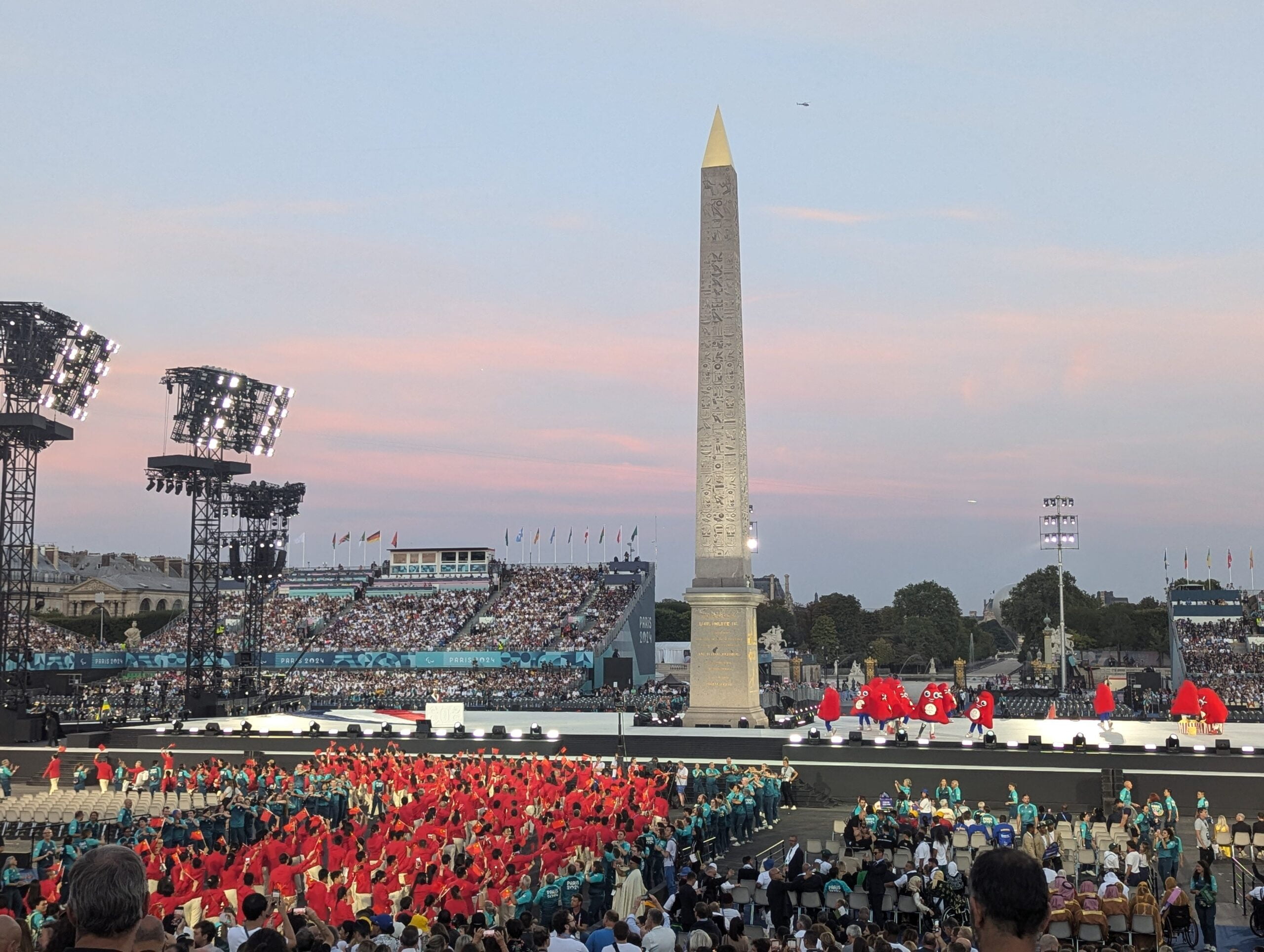
He was joined on stage by 15 life-size mascots, and an honour’s Guard of Paris 2024 volunteers lined the entrance to the historic square. They maintained coordinated dancing as each of the 168 delegations made their entrance, before joining the tail end of the parade behind athletes of the host nation.
The parade included three new National Paralympic Committees (NPCs), with athletes from Eritrea, Kiribati and Kosovo competing at the Paralympics for the first time.
On the fashion front, many nations opted for a nod at the tricolour in the details, whilst others including Great Britain, Iceland and Italy stuck to their sports kit. Standouts were luxe satin outfits in red and yellow from Belgium, while Indonesia sparkled in bejewelled burgundy.
The biggest audience reactions of the evening, aside from the expected jubilance for French athletes on home ground, was for the delegations from Palestine and Ukraine as well as the Paralympic Refugee team. Ukraine have a strong Paralympic track record in the pool and on the athletics track and, despite the ongoing conflict with Russia, have sent 140 athletes to the Games.
A performance highlight was Lucky Love singing an original song ‘My Ability’. Born without a right arm, he was joined by disabled and non-disabled dancers and accompanied by a gospel choir.
Tony Estanguet and Andrew Parsons, Presidents of the Paris 2024 Games and International Paralympic Committee respectively, delivered rousing speeches before President Macron declared the Games open.
Ahead of last night’s Ceremony, Estanguet said:
“We wanted this ceremony to be innovative, spectacular and truly magical, in keeping with this historic event: the first summer Paralympic Games in France.”
The 2024 Paralympics are anticipated as a historical catalyst for disability inclusion in Paris, echoed in Estanguet’s dubbing the athletes as revolutionaries during his speech:
“What makes you revolutionaries is that when they told you no, you continued. You have no limits, so let us stop imposing limits on you”
He also joked that the evening enjoyed “perfect weather”, in contrast to the heavy rain of the Olympic Opening Ceremony on 26th July. Parsons called the Paralympics “the most transformational sporting event on earth” and hailed Paris 2024 as the instigator of an “inclusion revolution”.
A sport-inspired dance piece featured whistle toots and martial shouts with choreography evoking athletics, rowing and taekwondo, as well as a lyrical solo and wave-like troupe motions. At moments reminiscent of a modernised Swan Lake (think Matthew Bourne’s seminal 1995 production) with its themes of exclusion, this piece morphed into a resolution of integration and togetherness, crutches waving overhead in synchronicity.

Luan Pommier performed a lyrical rendition of the Paralympic Anthem on the piano as the Paralympic Flag was raised. The Flag was carried onto the stage by Brit John McFall, a Paralympic sprinter who has been selected by the European Space Agency to become the first ‘parastronaut’, and Damien Seguin, a French Paralympic sailor.
Sébastien Tellier performed ‘La Ritournelle’ as the Paralympic Flame arrived on the lower Champs-Elysées. French 2024 Olympic medallist Florent Manaudou passed the torch to Michael Jeremiasz, former Paralympic Champion and this year’s Chef de Mission for France. Three defending Paralympic Champions of this year’s Games also passed the torch: Bebe Via (ITA), Oksana Masters (USA) and Markus Rehm (GER) as well as French parasport legends Assia El Hannouni, Christian Lachaud and Béatrice Hess.
Dancers with torches swirled to the strains of Maurice Ravel’s Boléro (If anyone’s seen the first season of Outlander, think of the intro but less witchy) as the final torch-bearers went on their way to re-light the cauldron: Charles-Antoine Kaoukou, Nantenin Keita, Fabien Lamirault, Alexis Hanquinquant and Elodie Lorandi.
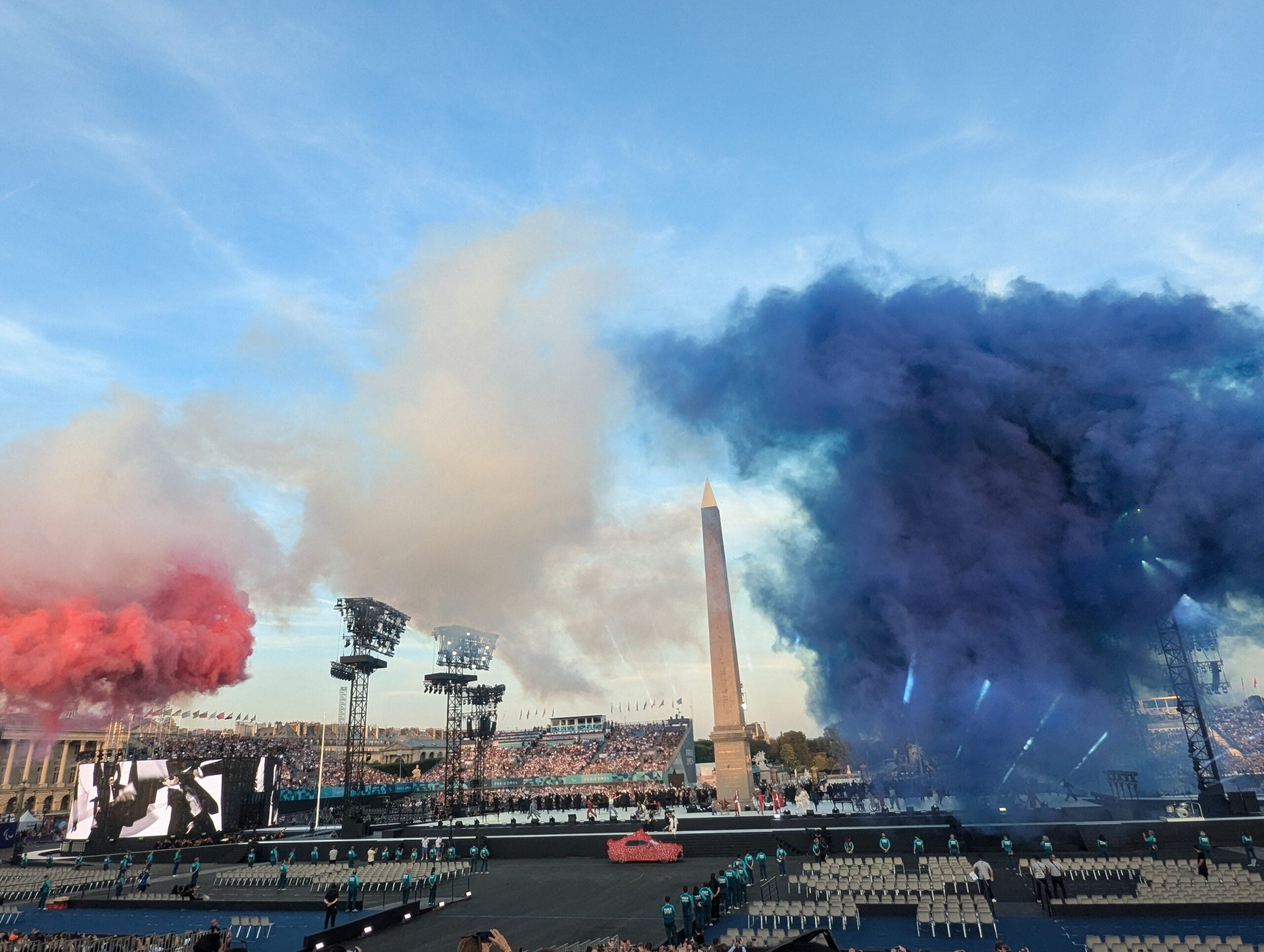
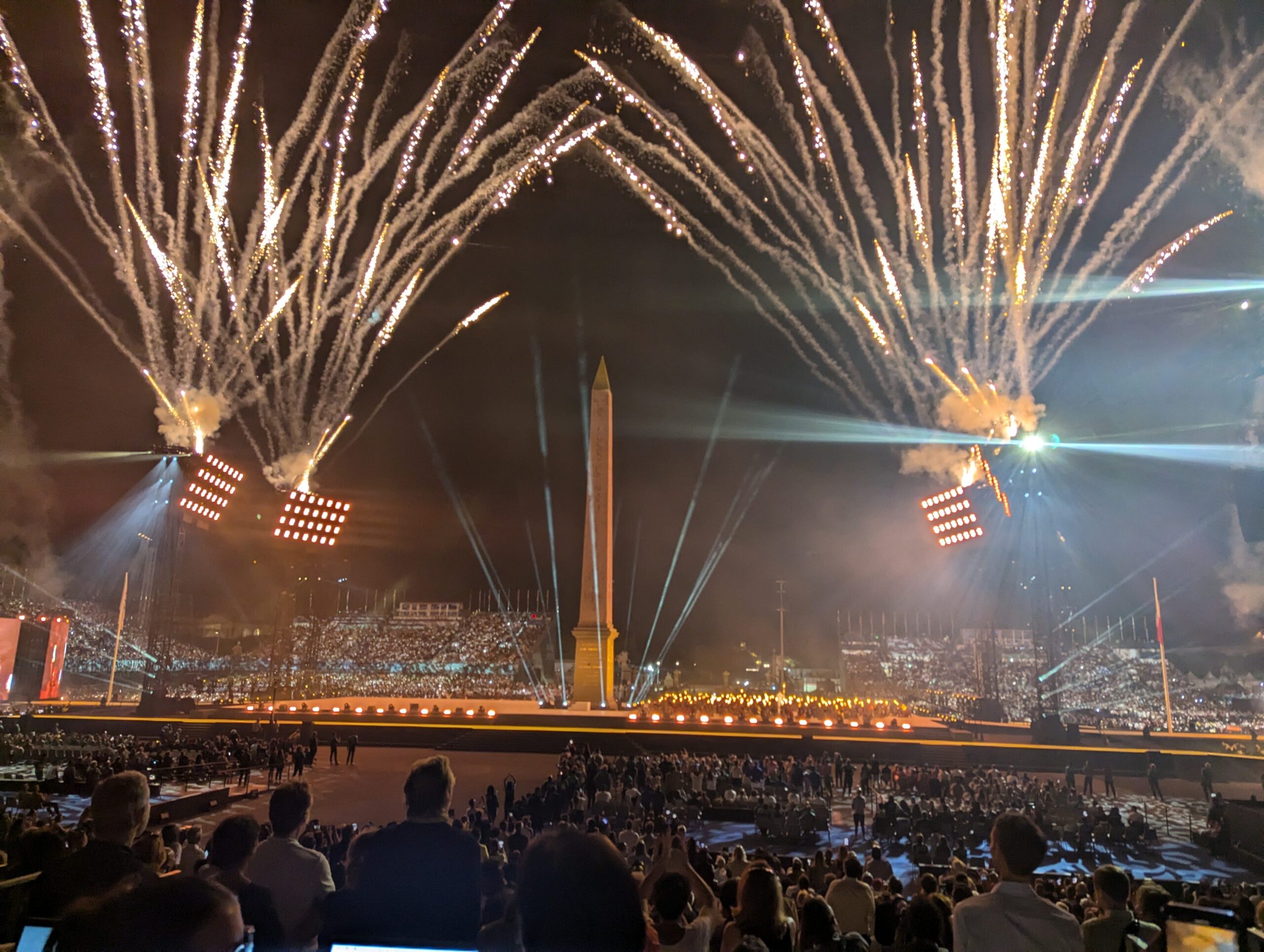
As the Cauldron rose into the air, Christine and the Queens returned to close out the ceremony with a rendition of ‘Born to be alive’, Patrick Hernandez’s disco classic, arranged for the occasion by Victor Le Masne. The show ended with dazzling colour and bursts of fireworks.
In the coming 11 days, we’ll see 4,400 athletes compete in 549 events across 22 sports. Over 2 million tickets have been sold, with limited availability remaining.
Let the Games begin!
by Lauren Lethbridge, ADJ Diploma Student