

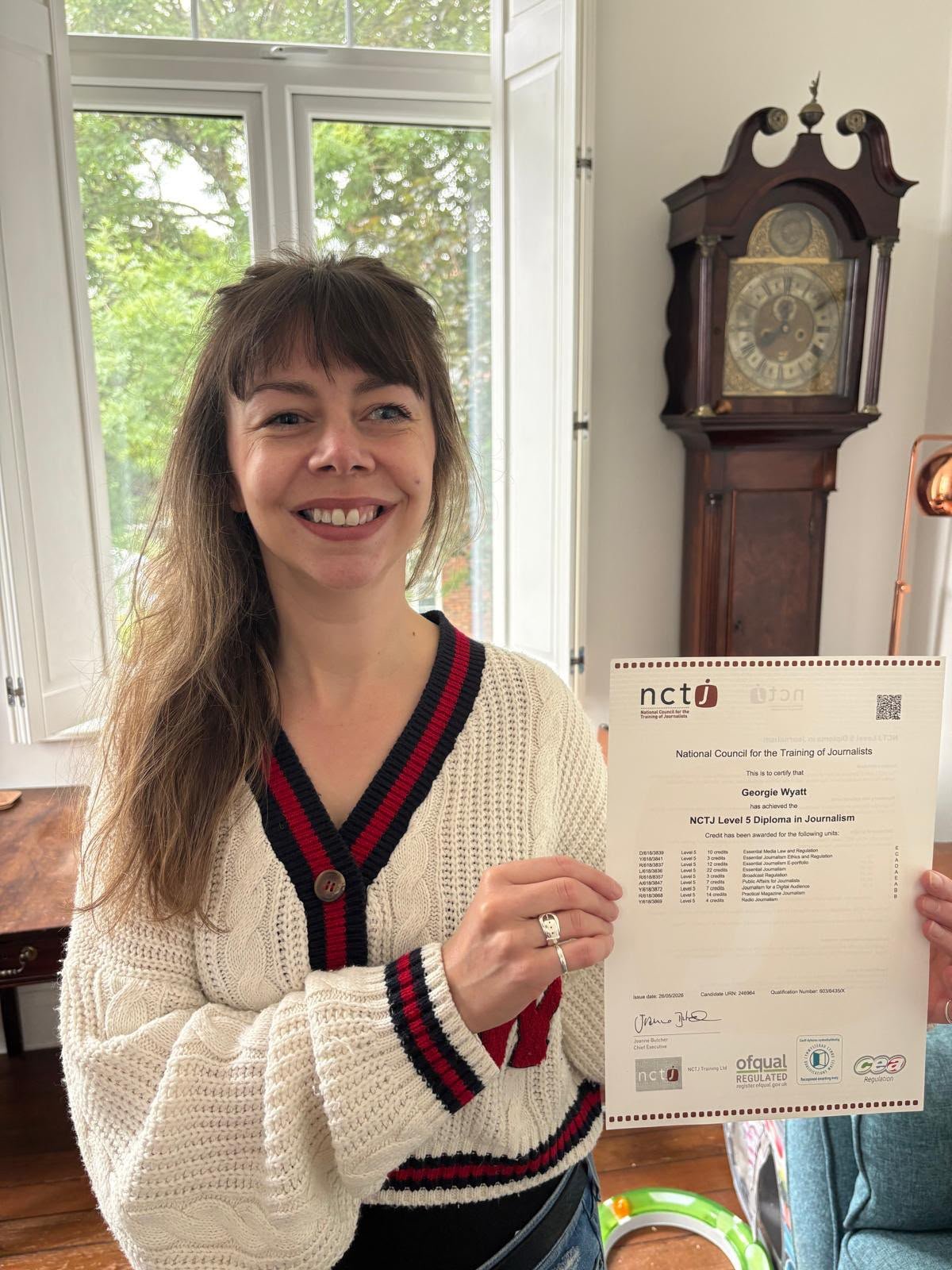
How disability, illness and determination led me from journalism student to Guardian writer.
I wanted to finish my Diploma before I turned 40, and I managed to do so with 8 months to spare. But only just. It wasn’t so much a journey to attain my journalism qualifications as an epic poem marred by obstacles and challenges, which, in hindsight, I couldn’t be prouder to have overcome. For me, living with a disability means being constantly underestimated by society. My hunger to prove naysayers wrong has driven me all my life. When life became insurmountable during my studies, I recalled the advice my eldest brother had given me over twenty years ago: “Nothing in life worth having comes easy.” It was Theodore Roosevelt who said it first, but it never felt truer than whilst I was studying for my journalism qualifications.
In my mid-thirties, I decided to pivot my career and retrain as a journalist. Storytelling has always been in my blood. I had started out in the arts and am still a scriptwriter and occasional actor. But it goes without saying that the arts and entertainment industry took a beating after the pandemic, and work has dried up. However, I have never been one to wait for an opportunity, and I refused to let my talents as a storyteller and a truly nosy person go to waste. I always knew I wanted to tell stories and find new ways to tell them. I should add that my qualifications are subsidised by Ability Today. Ability Today is a disability-led social enterprise and the Academy for Disabled Journalists; their mission is to create pathways into journalism for disabled people.
When I was offered a place with Ability Today’s Academy for Disabled Journalists, I instinctively said yes. So few organisations actively support, encourage, and generate Disabled employment opportunities. I am proof that Ability Today really does exactly what they promise to do. If you’re thinking of changing careers, always listen to your gut instinct. You never know where the adventure will take you.
I never planned to become a journalist as such. Before I applied, I had written three opinion columns for the Metro and got a taste for it. I also possess a curious nature, to the point of annoying and love sticking my nose into current affairs. During my CFJ studies, I quickly fell in love with journalism and the storytelling style it opened up. Never being satisfied that I have pushed my abilities and resilience to the max, I asked Grant Logan, Founder of the Academy about the Diploma in Journalism. I had become addicted to the rush that journalism offers. It fed my endless need to ask questions and get answers. The tight deadlines and immediacy gave me the buzz that performing on stage used to. I finished my CFJ at the same time as starting my Diploma. In hindsight, I wouldn’t recommend taking on both at once, though I often prefer to do things the hard way.
By 2023, after a few months of studying and loving my Diploma, I came down with what seemed like a stomach bug. Within 48 hours, I had sepsis and was under anaesthesia, having emergency surgery to remove my appendix. If you want the full story, it happened just before Christmas and became one of the bylines for the Guardian. It didn’t end there. My immune system was trashed due to a plethora of different antibiotics to treat the sepsis, including one that gave me a full-body rash. My immune system was at its most vulnerable, and of course, I caught COVID. Already, being immunocompromised didn’t help either, and sadly, I ended up with long COVID for six months. COVID, as a final insult, caused a flare-up of my juvenile arthritis. By this point, I was at my lowest physically and mentally. I had to set aside my studying and focus on regaining my strength. I cannot stress this enough: if, like me, you experience poor health and you need time to recuperate, please take that time. I have a terrible habit of beating myself up when I fall behind due to illness. I limp on even and make myself worse until eventually I have to call a time out.
However, thanks to a new biological drug and sheer willpower, I slowly got my mojo back. Getting my Diploma is amazing, and I couldn’t be prouder, but the world that it opened up to me in journalism was beyond my expectations.
Journalism is a vocation, and I believe it is best learned on the job. In 2024, I was accepted onto The Guardian’s two-week Positive Action internship and worked across features, culture and the opinions desk. The Guardian is often considered hallowed ground for journalists; it is one of the most prestigious and reputable legacy newspapers with an international reputation for excellence. I was terrified on my first day, and by my second day, I was ringing my boyfriend and crying down the phone to him, telling him,” I’ve made a mistake. I can never be a journalist!” It was nothing the Guardian did by the way. I was warmly welcomed by the team and put straight to work researching fascinating topics. The tears were a result of my own demons. Voices in my head telling me I wasn’t good enough for such a prestigious paper, and I was too old to try my hand at anything new.
I could have quit and run home, but I was offered the place because they deemed me worthy, and all I had to do was believe it myself. So instead, I put on my big girl pants, and not only did I have two of the most interesting weeks of my working life, but I am about to celebrate my 10th byline feature for the Guardian. I now regularly freelance as a features and culture writer for them and am part of their casual pool of writers.
In 2025, I was lucky enough to be offered a month of temp work covering for an assistant editor and fixer on the Guardian features desk. I got to experience the inner workings of how The Guardian operates and what they look for in writers. And to think I nearly ran home crying after my first day!
None of my achievements would have been possible without the support of Ability Today. When I was at my lowest and didn’t think I could complete my Diploma, they championed me when I needed it most. Their belief in me is and always will be instrumental to my success. Listen to the champions, not the voice of anxiety in your head. Put them on a train and wave them off from the platform!
I therefore leave you with a list of my advice to any students studying for their qualifications or starting in journalism:
Everything is material. Lived experience is a great commodity in journalism. Several of my bylines are from my life living with a disability. Others are about my childhood cat or a burst appendix! Never underestimate how interesting you are, and if you’re comfortable, harvest it for pitches.
Ask for help! Don’t be like I was and wallow in silence and think you can do it alone. Reach out to tutors, fellow students or your Ability Today. Trust me, people love to help and offer advice, so take them up on it.
Write for the editors. Regarding pitching, try to get to know the editors of the desks you’re aiming to write for. If you can’t meet them in person, read their work, interviews they’ve given, or the book they’ve written. Then imagine they’re in front of you, and you’re telling them your pitch.
‘The race is long, and in the end, it’s only with yourself.’ I can’t take credit for that quote-it’s from the 90’s hit Sunscreen by Baz Luhrmann! But my point is, don’t worry about what other people are doing or what they’re posting on social media. We all go at our own pace, and social media is not real life.
‘Fake it until you make it.’ This advice, again, isn’t my own but Taylor Swift’s, and it certainly worked for her! It particularly applies to your internship or work experience. When you’re asked if you can do something, say yes, give it a try, and go. Who knows, you might surprise yourself.
Criticism is not personal. If you get a note or criticism of your work from a tutor, it’s not to discourage you; it’s to make you better. Take it as a compliment. Whoever gave it to you sees your potential and wants you to achieve greatness.
By Georgie Wyatt – Academy for Disabled Journalists Alumni and Freelance Journalist
Insta: One_Eyed_Wyatt