

- Only seven in every 100 (7%) UK homes have basic accessibility features
- Amie from the Cotswolds spent eight years fighting for basic access to her own home
- Anyone with a disability or long-term health condition recognised under the Equality Act 2010 who has the correct documents, including PIP, Blue Badge, NHS Diagnosis letter, can access discounts and exclusive savings with Purpl
January 2026: With almost two million households across the UK still waiting for accessible housing, Amie, a disabled single parent from the Cotswolds, shares her eight-year battle to secure accessible entry into her home.
Millions of disabled people in the UK still face barriers to safe, accessible housing. A recent study shows that as few as 7% of UK homes meet the minimum standards for basic accessibility, leaving most housing stock entirely inaccessible for those with mobility needs.
Amie Greenfaery, a 45-year-old woman from the Cotswolds, is one of the disabled people affected by this. She describes her eight-year battle to access her front door.
Feeling Trapped in an Inaccessible Home
Prior to moving in 2017, Amie had been assessed as an urgent gold-band medical housing need, and when an opportunity arose to relocate closer to her then partner’s workplace, she moved, unable to anticipate the access challenges that were to come.
The property was a regular, two-up, two-down, with a garden space. After initial review, Amie was reassured that fixing the access to her new home would be a straightforward process. “They told me there would be no reason why the property that I’d picked would ever mean I’d be declined for a Disabled Facilities Grant,” she said.
A Disabled Facilities Grant (DFG) is a local authority grant intended to help disabled people pay for essential adaptations to their homes so they can live safely and independently.
Despite this, the housing association restricted access to works, ignored policy, reduced pathway lengths, and caused damage to her garden. Although it was later confirmed that vehicle access was inadequate, the process stalled amid repeated misinformation and shifting justifications.
Although all DFG applications should be decided within six months and the works completed within 12, many councils fail to meet these deadlines. National figures from Age UK show the average time from first DFG application to completed installation is around 18 months.
Amie was told front access would require a separate assessment and second DFG application, mounting further delays. During this time, Amie received three visits from occupational therapists who sympathised with her, but nevertheless, the process stalled, and she was left chasing many professionals.
One professional said she “already had a driveway” and asked why she wanted a new one. The professional went on to ask why Amie “couldn’t just park on the tarmac?” and use her wheelchair to get from the car and the roadside, which is over 25 meters away from her front door. She even received a message from the council saying they “did not do driveways”, despite the reassurance that she was eligible for a DFG.
Fighting to be heard
“There were several people who came out, but none of them seemed to know anything about the process. There were no meetings, no arranged appointments or anything. Then I was told that they had made a decision and that the DFG would go ahead, and they shared the picture of the plan. I was absolutely distressed and dismayed at what was suggested, a total of 15 different slabs of concrete using gravel in between, which a powered wheelchair cannot go across. They added a ramp to the front door that was completely unnecessary and no loading or unloading area for my wheelchair, my child, my assistant’s dog, or for me to actually enter or exit the car.”
Amie wrote to the council to point out that their plan was not accessible and even redrew the driveway plans herself, identifying serious flaws and proposing a simpler, low-cost alternative, which an occupational therapy supervisor agreed was preferable to the council’s overly complex and inaccessible design.
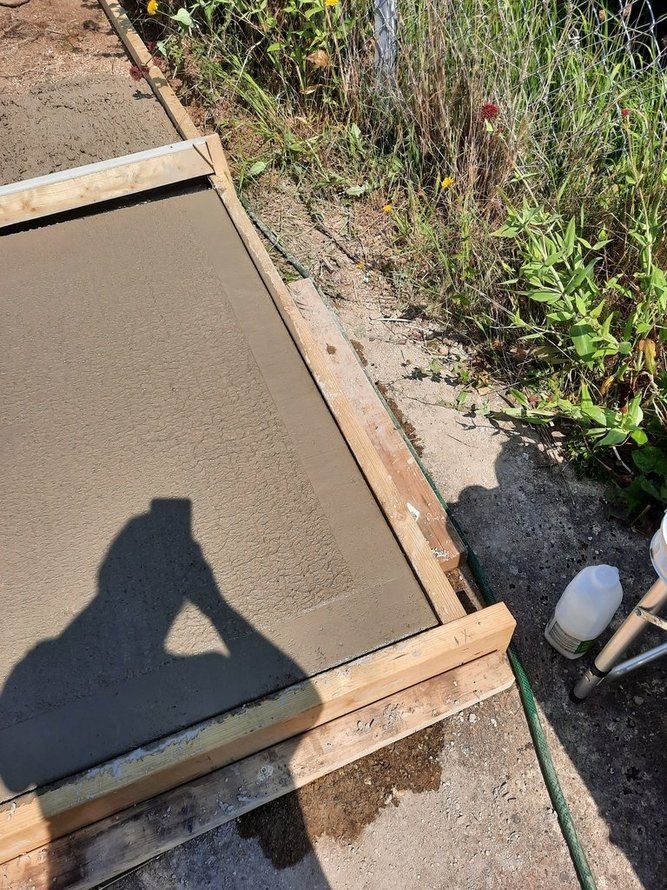
A final plan was issued via email, but without Amie’s consent. Despite Amie’s complaints, construction commenced with no prior consultation, resulting in even more failures, creating new hazards, including a six-inch step where none had existed before.
“As a single parent with a child who’s got pathological demand avoidance, this stressed me out even more, and I insisted that they visit the property because they didn’t believe the photos”, said Amie. “The worst bit was when the builders said the step would remain for 6 weeks minimum. I was threatened with the temporary ‘fix’ which I knew would not be made of a metal fold-out ramp.”
Amie’s complaints were eventually upheld, with findings of failures in communication, consultation, and process, including the lack of proper handover, occupational therapy sign-off, and any schedule of works. Her driveway was eventually finished, and after her eight-year ordeal, in 2025, she was awarded a total of £950 in compensation from the local government ombudsmen in April 2025 and the housing ombudsman in November 2025.
“They had ample opportunities to do the right thing; however, what has actually occurred has been devastating to my family and me, and it has caused so much distress,” Amie said. “It stopped us from being able to go anywhere or do anything. The sensory overload made me have a breakdown on Zoom in a meeting one day because the ringing in my ears was horrible from the pneumatic drilling. My son and I rely on being able to go where his education takes us, and we were trapped.”
Disability advocate and founder of Purpl Discounts, Georgina Colman, said: “Disabled people already face significantly higher living costs, and when essential adaptations are delayed, denied, or mishandled, many are left with no choice but to pay out of pocket, attempt unsafe workarounds or live with a home that doesn’t work for them. Accessibility should never be treated as optional or excessive; it is a fundamental right.”
As a disabled person myself, I know firsthand how much extra we have to think about every day and how often it comes with a financial cost. That’s a big part of why I started Purpl. I’m proud that we’ve been able to partner with homeware brands to help disabled people save money on appliances, home furnishings and everyday essentials that make life that little bit easier.”
Purpl Discounts is a savings platform for disabled people and people with long-term health conditions. The platform has helped people save £2 million collectively and works with several homeware brands such as Dunelm and Furniture Box.