

Diploma in Journalism
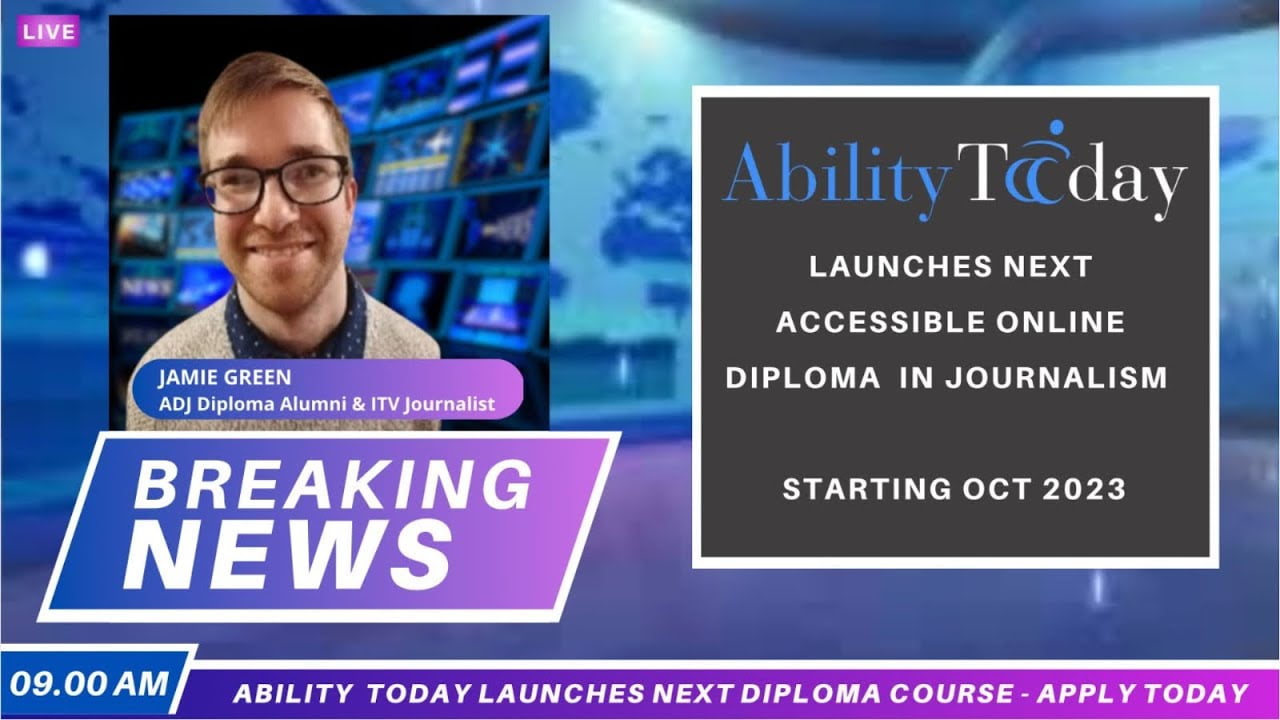
REGISTER YOUR INTEREST FOR OUR NEXT COURSE BELOW
Are you looking for a career in journalism? Is your dream to become a paid journalist reporting on the world around you? Do you have a disability and have always felt the barriers to study are too high?
The Diploma in Journalism online course is in partnership with the National Council for Training Journalists (NCTJ). This qualification is equivalent to a foundation degree and is what many editors consider to be a prerequisite for junior reporter roles.
Through our Academy this part time level 5 qualification course will be delivered in a fully inclusive and accessible online environment, allowing our students to study from home at their own pace, taking into consideration individual’s needs and requirements.
The course will be delivered through a mixture of self-study (on the NCTJ’s e-learning platform) and tutor-led workshops. The workshops will take place online over a 3 term period, with 10-14 weekly 1.5 hour live sessions per term. Each session will be recorded with live captioning by a stenographer and made available online for further viewing and revision. We are aware that some students have a preference for BSL and we are currently seeking funding to provide this in the future.
We are looking for the strongest candidates with a proven passion and dedication to make journalism and working within media a career path. The National Lottery funding is enabling us to provide highly subsidised access to the Level 5 Diploma and provide this in a fully accessible online environment.
Please note that all modules involve timed exams. These can be done online provided that students have the necessary equipment. Alternatively, students may be able to take exams in person, but will be required to travel to an approved exam centre. Please read the additional course information below before applying.
Membership to the Academy and cost for the Diploma in Journalism including exams is £399 inc VAT. The true cost of the course would be over £4000.
The NCTJ technical minimum academic requirements for sitting the Diploma are 5 GCSE passes at level 4 or above (including English). If you’re unsure if the Diploma is right for you, you can access the entry test below. We recommend you have a go:
The NCTJ technical minimum academic requirements for sitting the Diploma are 5 GCSE passes at level 4 or above (including English). If you’re unsure if the Diploma is right for you, please visit the NCTJ’s website (www.nctj.com) for further information or contact us for a discussion. You can also access the entry test below. We recommend you have a go as the Diploma is a challenging qualification and will require a significant commitment:
Self Entry Test
Marking guide for above Self Test
Self Entry Test 2022
Marking guide for above Self Test
If you have a disability and are in receipt of DLA or PIP you will be eligible to apply for the course. If you are not in receipt of DLA or PIP, a Doctor/Consultant letter confirming your medical condition will suffice. Please get in touch if you have further questions.
All applications must be submitted by TBC. All successful & unsuccessful applicants will be notified by TBC..
The first weekly online session will commence at 11am on TBC. All sessions are recorded for future reference and revision. Students will be required to attend the weekly classes online via Zoom. We understand that due to illness, health conditions or other commitments that some classes may be missed. We are here to support you on your journey.
Any questions please contact us at info@abilitytoday.com
Course Information
Membership to our Academy will include the following benefits:
- Unique Access to The NCTJ Level 5 Diploma in Journalism
- Exclusive Webinar based tutorial content (45 + hours)
- Masterclasses delivered by prominent industry leaders
- Access to NCTJ’s Diploma Resource Portal
- 1 hour of 1-to-1 Tutor support per module
- Student Press Pass
The NCTJ level 5 Diploma in Journalism is an industry recognised qualification. Gaining the full Diploma qualification (especially at ‘gold standard’ – ie A-C in all subjects) will stand you in excellent stead when it comes to seeking employment within the news journalism sector.
We have worked closely with the NCTJ to devise a course which will enable students with a wide range of abilities to participate and gain a valuable qualification.
The course will combine self-study on the NCTJ’s e-learning platform and webinar-based tutorials (totalling 51 hours) led by NCTJ-approved trainers. Please note that self-study is essential to the successful completion of the course; you are very unlikely to pass by only attending the webinar tutorials.
There is no upper or lower limit to how much self-study you are expected to undertake: each individual is different. However, as a guide, the NCTJ recommends you could spend up to 820 hours in total learning to complete the qualification (including all teaching, self-study, revision and exam time). You should expect to spend up to 15 hours per week on self-study, as well as attending the online sessions. Each candidate is also entitled to an additional hour of one-to-one tutor support per diploma module.
The taught course will be split into three terms, with a total of 36 weekly, 1.5 hour live sessions, starting on TBC and ending with a wrap-up session on TBC. There are breaks at Christmas and Easter. All webinars will be filmed and made available online for anyone that misses a session.
During this period, you will study the following modules of the Diploma in Journalism (the first four are mandatory, and the remaining two have been selected for study on this course):
Essential Journalism
Essential Journalism Ethics & Regulation
Essential Media Law
e-Portfolio
Public Affairs for Journalists
Journalism for a Digital Audience
The course will be focussed towards exams in those modules, which will take place on the following dates (in the afternoons):
13th November – Essential Journalism Ethics & Regulation (30 minutes)
20th January – Essential Journalism (2 hours)
12th March – Essential Media Law (2.5 hours)
13th June – Public Affairs for Journalists (1.75 hours)
18th June – Journalism for a Digital Audience (1.5 hours)
The e-Portfolio (showcasing your work across various formats) should be submitted by the end of 2025 if possible.
Should a candidate not be able to sit exams on the above dates, there are subsequent opportunities, but please note that NCTJ exam sittings take place only three times a year (or twice a year for some modules).
Once you have successfully completed exams in the above modules, you will be entitled to select your remaining elective modules (three single modules, or one single and one double module) in order to gain the 35 further credits required to complete the diploma qualification. These will be undertaken via self-study only. While we will not run group workshops on these modules, each candidate will be entitled to book up to an hour of one-to-one tutor support per module. You should aim to complete your final modules by the spring, but this is not a hard deadline. The Academy will aim to support students up to 2 years from the course start date to accommodate individual requirements.
As distance learners, you will probably sit your exams remotely, using the NCTJ’s online exams system, Cirrus. In most situations this will be possible, but please be aware of the following –
- You must have access to a secure, private room in which to take your exams.
- You must have a secure, stable internet connection in the location you plan to sit; and your exam computer must have at least 2GB of free RAM and a working webcam and microphone.
- The NCTJ uses remote invigilation technology (Proctorio), which requires you to complete a full 360 degree room scan and full desk scan with your webcam prior to the exam starting.
- You must not leave your desk for any reason during exams unless you have an agreed reasonable adjustment, approved by the NCTJ, for 50% or 100% extra time, rest breaks and/or medical bathroom breaks.
- Reasonable adjustments must be agreed well ahead of exams (preferably at the outset of your course); if late requests for adjustments are made, we may not be able to process them in time for you to sit your exams. The NCTJ does not offer alternative forms of assessment beyond the exams sat by all candidates.
Some of the elective modules that you can choose from to complete the qualification through self-study (eg Videojournalism) require specialist software (eg video editing software) and are invigilated via Zoom. Please note the software is not provided by the NCTJ.
In the event that you cannot meet the requirements for sitting remote exams, or a remote sitting is not suitable for unforeseen reasons, you will have to sit your exams in person at an approved NCTJ centre. You will need to make your own travel arrangements, bearing in mind that you may need to attend a centre in London, or the NCTJ’s offices in Essex. This will also apply if you require the use of voice-recognition or other software (eg Dragon), which is not compatible with our exams platform (Cirrus) or invigilation technology (Proctorio).
Partnering with the NCTJ has given the Academy the ability to provide direct mentoring and teaching support and to tailor the course for the needs of learners with a range of disabilities. These additional resources are not normally available through the NCTJ’s distance learning courses.
We work closely with the NCTJ to ensure any reasonable adjustments are put in place to allow our students full and equal access to the exams. If you would like to discuss possible adjustments ahead of your application, please contact us.
To complete the Diploma in Journalism you must achieve A-E grades in all modules taken (achieving a minimum 82 credits) and a minimum 60wpm shorthand if that option is taken. To gain the industry ‘gold standard’ in the diploma you must achieve A-C grades in all modules taken (achieving a minimum 82 credits) and 100wpm shorthand if taken.
Ability Today’s online news platform is the perfect place for our student’s new content to be created and published. Our Academy will provide students with the unique ability to develop and hone their journalistic skills and deliver their content directly to our targeted audience.
Course requirements
- Laptop / Computer
- Internet connection
- Smartphone for audio recording and filming
- Zoom application for tutorials
- Word Processing software (MS Word / Google Docs)
- The NCTJ Level 5 Diploma in Journalism is suitable for those aged 18+ and educated to 5 GCSE passes at level 4 or above (including English)
To sign up to become a member of the Academy (ADJ) and apply for the Diploma course please email info@abilitytoday.com with your details or fill out the form at the top of the page.
For further information on the DIPLOMA in Journalism View details in NCTJ website
All sessions will be held via Zoom and the recordings made available to watch on the NCTJ’s e-learning platform.
For more information about the Academy for Disabled Journalists or Ability Today please email info@abilitytoday.com with your details.