

Olivia Gallagher was denied the opportunity to go to Paris 2024, but despite that, she is still fighting and determined that a Paralympic Medal will one day be hers, in the meantime she is calling on the government to look at funding for higher support need categories.
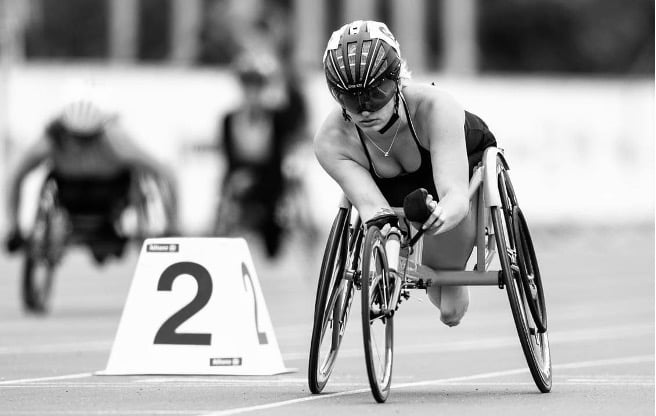
Olivia Gallagher, is an elite athlete, named a top 100 most influential disabled individual, in the disability power list and a Pride of Britain Young Sportsperson of the Year 2018. She is an Ambassador for Ability Today, as well as being ranked British and World Number one in the T33 classification.
Olivia did not have a great start to life. Born prematurely at 24 weeks and the only surviving baby of triplets, she went through challenges with her sight and vision and was diagnosed with Cerebral Palsy. She spent the first part of her life, feeling like she did not fit in, and isolated from the world.
However, in 2012 things took a change for the better, and she suddenly found herself in a world where she felt accepted.
“2012 enabled me to say I could be good at something. When David Weir won his fourth medal in the 5000 meters was just incredible and then 13 months later, to meet David, Jenny Archer, to this day they have both been a massive inspiration not only to me but to thousands of athletes.”
2012 left behind a legacy for many disabled athletes, not most David Weir, 6 x Paralympic medalist and 8 x London Marathon winner, who set up the Weir Archer Academy with the help of his coach Jenny Archer.
In 2014, after a suggestion from her dad, Olivia stepped foot into the Weir Archer Academy as one of the first athletes to do so. “That is a privilege, not many athletes have,” Olivia said.
For Olivia, to find somewhere and with people who accepted her for herself and all her disabilities, has been a massive asset moving forward. Olivia has multiple complex disabilities including, a visual impairment, a hearing impairment, and difficulties with her mobility. Olivia said, “Jen and Dave have taken it upon themselves to believe in my potential on the track and in my potential as an athlete and that’s where it’s been a massive asset to me moving forward.”
The training received from the Weir Archer Academy has allowed Olivia to grow as an athlete. Jenny and Dave adapted their way of teaching to give them some of the perspective Olivia was experiencing on the track to help her progress, they did this by covering one eye so they could envisage what she was seeing on the track. It worked as she was able to go in a straight line for the first time without going from lane one to lane 8.
By 2018, Olivia represented England in the CP World Games and won Silver in the 200m and silver in the 400m. Later that year she was awarded the Pride of Britain Award for Young Sportsperson of the Year 2018.
2019, she was ranked UK number one and World number 1, in her classification T33.
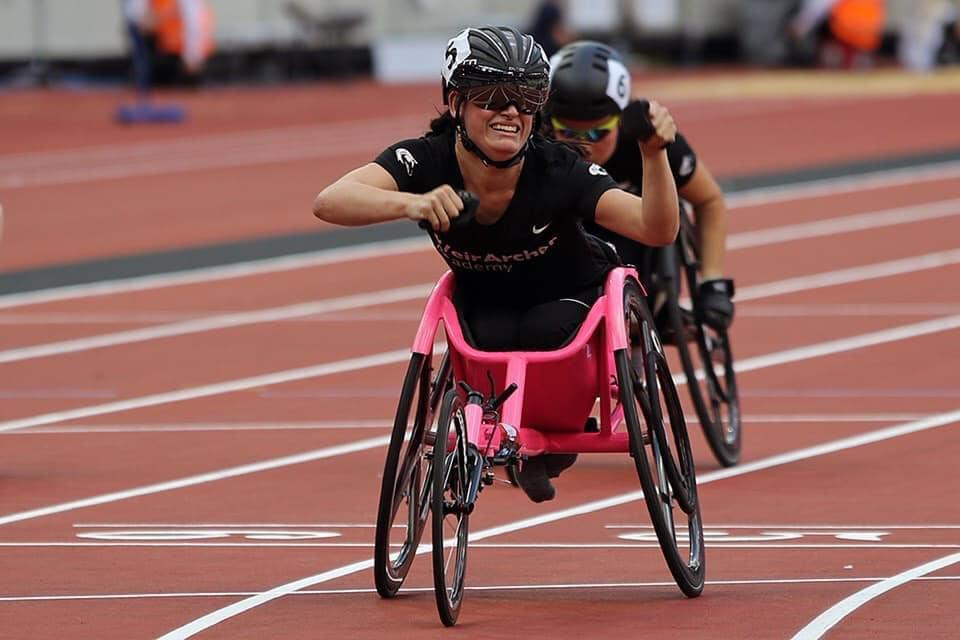
Olivia’s classification, for individuals with Cerebral Palsy, is classed as a high support category, and one which she says is not funded by the government.
Despite, the success Olivia has had on the track, she has been denied the opportunity of representing her country at the Paralympic Games for the past two cycles. This is due to the IPC, not supporting the T33 category.
Their decision is said to be down, to not enough athletes taking part in the sport overseas. Over the past few years, more athletes have moved sports or have decided there is not enough support to continue.
Whilst Olivia, took a break to support her physical and mental well-being, she came back determined and has said change is needed as the Paralympics do not provide the equal opportunities, they say they do, especially to those in the high support categories.
“That’s where it needs to change, and we need to be like a business when you’re trying to drive change and you’re trying to drive inclusion and diversity. It’s got to be like a business structure moving forward and they’ve got to be willing to listen to people that have personal experiences of that discrimination.”
Olivia was not the only person to miss out on the Paralympics this year in the T33 category. Andy Small who won gold in Tokyo in the 100m, was also told 10 weeks after returning that he would not be getting the chance to compete in Paris.
Andy was the captain of the torchbearers at the Channel Tunnel for the passing of the Paralympic Flame, and speaking to his mum and dad Jenny and Steve after said “Andy, was deeply disappointed to hear he would not be going, there were others in his category that also got the same news and to put in all that hard work and not be able to represent your country was upsetting.”
Olivia is not letting the fact she missed out on these Paralympics, get in her way of success with her sights firmly set on LA2028. However, this time her sport and classification will be slightly different.
“The F32/33 has been confirmed for the LA Paralympics, and on the track, I will be combining it with the T34. I enjoy the 800m and I am one of the fastest 800-meter athletes in the T33 category, worldwide to this day. I want to break that world record and the European record, and I strongly believe I can do that. But to do that, I need to have something realistic alongside, hence why I’ve chosen to take up the field as well.”

Olivia strongly believes London 2012 changed people’s perspective on disability and how it changed people’s perspective on disability, how they see disability, and that every disability is not the same. And it enabled people to say that even though you have a disability, anything is possible.
However, there is still a long way to go to make the playing field equal. Olivia opened up about the financial challenges she has as a self-funded athlete with no Paralympic pathway. To date International Competitions have been self-funded by her family.
Without the help of Sponsorship, being able to carry on to the level she is capable of, will be challenging, especially when her classification is not on the Paralympic Cycle.
“When you’re looking at the finances of the sport, wheelchair racing, it’s expensive and it’s hard to get sponsorship. The only reason I’ve been able to get sponsorship is because I’m a talented athlete. I’m a dedicated athlete. People have seen my potential, but even that has only covered my chair and It covered 8 competitions internationally. But I’m now looking for long-term sponsorship in the lead-up to LA because even if I get some sort of funding, it’s still not going to cover everything. Especially if I’m going to be juggling track and field.”
Olivia has called on the International Paralympic Committee to listen to athletes regarding funding “Unless I’m doing the top three, top four, in the world time-wise for T34, then I won’t be on funding”. More has to be done to encourage athletes in high support needs categories.
“I’ve done this for 10 years and I’m going to be walking into the next Paralympic cycles with a realistic pathway and goal for the first time. It has not been easy to make that decision.”
Whilst Olivia is keen to make it heard that equal opportunities for all Paralympic athletes is not always there, she is equally as keen to make it known that the community out there to support each other is strong and that sharing stories can be inspiring to many.
Olivia recently had cochlear implants, and by sharing her story someone reached out to her who was looking to go through a similar experience.
“Disability is a community and Paralympic sport is a community, para-athletics is a community. Whether you’re an elite athlete, at the very top of your game or not, even when you’re going to be retiring, you’re still going to be involved. It is a community of people that all share the same identity as being disabled, but we all have unique factors that make us all unique in our own way.”
Olivia owes so much of her success to the Weir Archer Academy but also through her willpower and drive.
“I may not have got to Paris but I’m going to come back more dedicated. I’ve got to wait another four years, but I know that my time will come.”
With LA in four years, a lot can happen, and with Olivia’s mindset to break records, her journey will surely be an exciting cycle.
by Victoria-Jayne Scholes, ADJ CFJ Alumni & Diploma Student
https://www.legallypowered.co.uk
For more information on wheelchair racing: